Showing posts with label Quadratic Functions. Show all posts

September 20, 2006

Word Problems Involving Parabolas

Hi everyone.
Well, we started today's class by solving two problems which were due as home work. We (most of the class) had a hard time trying to complete the square because of one of the questions because of FRACTIONS.
Mr. K. used another problem (easy one) to illustrate the use of fractions.
The easy one was: y=3x^2 + 12x +4
to complete the square we can factor the 3 out.
y = 3[x^2+4x+4] then complete the square
y = 3(x+2)^2

The other way was to use fractions.
y = 3x^2 + 4x +4 complete the square while placing the "+4" outside the bracket.
y = 3[ x^2 +4 +_ - _ ] +4 now lets try to complete the square inside the bracket


Remember:
In order to complete the square in the general formula (AX^2 + BX + C) ,C have to be (B/2)^2 in other words (B*1/2)^2
Therefore to find the C for y=3[x^2 + 4x +__ -__] +4 we have to multiply by 1/2 then square. (4*1/2)

Therefore
y = 3[x^2 +4 +(4*1/2)^2 - (4*1/2)^2] +4
y = 3[x^2 +4 +(4/2)^2 -(4/2)^2] +4
{{{Reminder: don't square the +ve number we added, because we will soon need its square root.}}}
y = 3[x^2 +4 +(4/2)^2 -(16/4)] +4
y = 3[(x+4/2)^2 - 16/4] +4 ... MULTIPLY THE 3 IN.
y = 3(x+4/2) ^2 - 48/4 + 4 ...to add these two numbers we have got to have the same denominator.
Therefore
y = 3(x+4/2)^2 - 48/4 + 48/4
y =3(x+4/2)^2
y = 3(x+2)^2

"NOW LETS DO THE REAL FRACTION STUFF"

Lets change this (from general form to the standard form):
y = 6 + 5x - 2x^2 ...rearrange
y = -2x^2 +5x +6...factor -2 out
y = -2[x^2 + 5/2x +__-__] +6...to get the absolute value which completes the square we have to get the middle term times 1/2 then square it. = (5/2 * 1/2)
y = -2[x^2 +5/2x +(5/2 * 1/2)^2 -(5/2 * 1/2)^2] +6

y = -2[x^2 + 5/2x + (5/4)^2 -(5/4)^2] +6...remember: don't square (5/4)^2 because we will soon need its square root.
y = -2[(x+5/4)^2 - 25/16] +6...Multiply the -2 in.
y = -2(x+5/4)^2 + 50/16 +6...Simplify the fraction.
y = -2(x+5/4)^2 + 25/8 +6 ... change 6 into a fraction where by its denominator is 8
y = -2(x+5/4)^2 +25/8 + 48/8
y = -2(x+5/4)^2 +73/8
Now we should be able to estimate these fractions. For example 73/8 is about 9.1 & -5/4 is about -1.3. The vertex is (-5/4,73/8)...or...(-1.3,9.1)


WORD PROBLEMS INVOLVING PARABOLAS

Usually there are 3 types of these problems. These problems wont be given in the standards form. They will either be in the general/factored form.


ONE :
Grad tickets are sold for $20 each, and 300 students are willing to buy them at that price. For every $5 increase in price there are 30 fewer students willing to buy tickets what is the maximum Revenue?
Rephrase the Q: how many times should they increase the price in order to get the maximum Revenue ($$$$$$$ get it?)

Legend:
X= increase in price by $5
Therefore:
Revenue= (cost/ticket) (number of students willing to attend)

Revenue as a function of X (depends on X)
This is in the factored form

(x) How many times the price is raised by $5

REVENUE (X) = (20+5x) (300-30x)

(300-30x) The original students willing to attend minus the number of students who wont be willing to buy tickets (3o students) each times x raises by one.

(20 + 5x) The original price + $5 each time value of X increases by one.

R (x) = ($20 + $5x) (300 - 30x)
Roots (Zeros) = -4 and 10
because (20 + 5(-4)=0 and (300 -30(10))=0

The axis of symmetry or X= -4 +10/2 = 3

Therefore R(3)= [$20+$5(3)] * [300-30(3)]
R(3)= ($35/ticket) (210 students will attend)
Revenue(3)= $7350

TWO:
A toy Rocket is shot upwards from a height of 6 meters. its height, in meters, above the ground after "t" seconds is given by h(t)=6 + 80t -5t^2 ...
h(t)= -5t^2 + 80t +6 <<<<<
a} After how many seconds does it reach its maximum height
?
Rephrase: what is the axis of symmetry?

h(t)= -5t^2 + 80t +6
h(t)= -5[ t^2 -16 +_ -_] +6
h(t)= -5[ t^2 -16 +64 - 64] +6
h(t)= -5[ (t-8)^2 -64] +6
h(t)= -5(t-8)^2 + 320 +6
h(t)= -5(t-8)^2 +326

Since h in the above a(x-h)^2+k equals 8. Therefore the axis of symmetry= 8
Rephrase: The rocket will reach its max. point after 8 seconds.

b} What is its max. height?
Rephrase: What is the h co-ordinate of the vertex, or what is the max point of the parabola? (because it opens downwards ...).

Since the vertex = (8,326), the max point, or the h co-ordinate of the vertex= 326 meters

I will insert the graph tomorrow, and if there is something wrong with calculation i will make sure i check with Mr. K
THIRD:
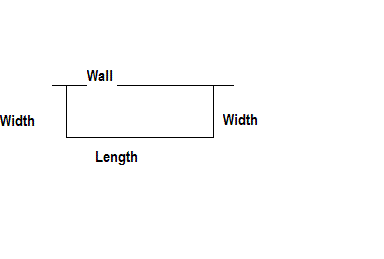
Find the maximum rectangular area that can be enclosed by 160 of fencing if one side of the rectangle is an existing wall.


Width*2 + Length (one side)= 160
Therefore: Length = 160-2w

Lets find the table of values.
Width ....Length ....Area
10 ........140 .......1400
20 ...........120 ......2400
30....... 100....... 3000
40 ...........80...... 3200
50 ...........60..... 3000
60 ..........40........ 2400
and decreases

Area(w)= (160 - 2w)w
Roots
0=160 - 2w
160 = 2w
80=w

Therefore the roots are zero and 80. Zero because if we replace w by zero it gives us zero
Area(0)= (160-2(0))0
= (160)(0)
=ZERO!

h=0+80/2
Therefore h=40!


Uffffff...let me take a breath...ok...my last thing. THE NEXT SCRIBE WILL BE.
\You are right Lauressa (: ...You are the one!


September 18, 2006

Quiz 2: Quadratic Functions

Okay, I'm your scribe for today and as you might've already guessed, I'm Sandy. By the way Cherrie, great job on your scribe! As for myself, I hope I can do just as good. Except we didn't do that much in class today. We started with talking about today's homework which I'll get to later. We then went onto reviewing this weekends homework.

Today we seemed to be confused on how to fill in the table that was for homework. The first equation we did looked at was:
f(x) = x2 + 5x + 6.

The first thing we would do with this is factor the equation..
f(x) = (x-2)(x-3)

Now that we've factored the equation, we're able to pin-point the roots/ y-intercepts/ zeros.
2, 3

**REMINDER: Don't forget to switch the signs (-, +)!
Negative (-) to positive (+) and vice versa.

Okay, so we have our roots and having the roots we can easily find the Axis of Symmetry.
Step 1: Add both roots together.
2 + 3 = 5
Step 2: Now that we have the sum of the two roots, we divide by 2 to find the center of the roots which is the Axis of Symmetry.
5 / 2

NOTE: It's a lot easier to work with fractions than decimals!

So the answer to what the Axis of Symmetry is:
x = 5 / 2

**REMINDER: Don't forget to put x = before the numbers!

Now that we've found the
Axis of Symmetry (which is also the x-coordinate of the vertex) we're able to plug that number into the equation f(x) = (x-2)(x-3) to find the max or min value(which is also the y-coordinate of the vertex). This is how:
f(5/2) = (5/2 - 2)(5/2 - 3)
f(5/2) = (5/2 - 4/2)(5/2 - 6/2)

Lets stop right there just in case anyone doesn't understand how we went from - 2 to - 4/2 and from - 3 to - 6/2. Well going back to grade nine or so, we should know that when adding fractions the denominators have to be the same. And knowing that whatever we do with the bottom we must do to the top, we multiply the bottom (1) by 2 to be the same as 5/2 and then multiply the top (2) by 2 as well. The result is 4/2. We do the same for the - 3.

Continuing...
f(5/2) = (1/2)(-1/2)
f(5/2) = - 1/4

Your answer should look like this:
min y = - 1/4

And there you go, you've got
your max or min value.

Okay! So lets recap.
- By factoring the equation we found the roots. 2, 3
- and with the roots we easily found the Axis of Symmetry. 5/2
- Knowing that the Axis of Symmetry is the x-coordinate of the vertex, we found half of the vertex. ( 5/2, ___)
- Plugging the Axis of Symmetry into the equation we found the max or min value which we also know is the same as the y-coordinate of the vertex. ( 5/2, -1/4 )

We're not finished yet, though. The easiest way to figure out if the parabola opens up or down is to look at the the sign (-, +) in front of the equation itself. Looking back at the original equation there was a + sign:
f(x) = x2 - 5x + 6

The answer for whether this equation opens up or down is:
UP.

As for domain, everyone should know that. Like Mr. K says,
"It's a gimme!"

With these particular parabolas, the domain with always be:
D: (- oo, oo)

The range (y-axis) is, just like the domain, smaller number, comma, then the larger number. This
parabolas smallest number is the max or min value. If the number is a max value, the number goes where the "larger number" is placed -- after the comma. If the number is a min value, the number goes where the "smaller number" is placed -- before the comma. In this case, we have a min value so the range should look like this:
R: [-1/4, oo)

--------------------------------------------

The second thing thing we went over was question 2 on the worksheet. It looked like this:
Find the equation of the quadratic function given its vertex is (1, -2) and a point on the graph at (-2, 16).

The first thing we should do is find the easiest equation to put this information into. This happens to be this:
y = a(x-h)2 + k

We know the vertex so we can easily put those numbers into the equation so it looks like this:
y = a(x-1)2 - 2

We also know a point on the graph which are the x and y coordinates! Those fit into the equation as well like so:
16 = a(-2 -1)2 - 2

Now all we have to do is solve for a!!
16 = a(-2 -1)2 - 2
16 = a(-3)2 - 2
16 = a(9) - 2
16 = 9a - 2
16 + 2 = 9a
18 = 9a
18/9 = 9a/9
2 = a

Now that you have a, you can now find the equation for the quadratic function.
y = 2(-2 -1)2 - 2

Alright! I think i've covered everything and there you have it. With the simplest information you can find EVERYTHING you need. Great hey? (=

Today's homework is:
1.) Sign up for the websites that Mr. K posted up.
2.) Exercise 6!
Have fun guys!

ANNDD..
Last but not least, tomorrows scribe will be...
.
.
.
.
.
.
melissa!!
Have fun! =)

September 14, 2006

In search of the parabola's vertex...

Today's lesson was a combination of a review from other classes and new things that goes a little more in-depth on parabolas. For example, this is what we put in our Math Dictionary, but due to a shortened period of time (we had an assembly and before that, a quiz), this is all we could write. (I'm a luckier scribe! =P) "I won't be posting what we reviewed because all the things that we reviewed are posted after this post {scroll down}."

There are 3 different forms of equations:

standard form: f(x) = a(x - h)
² + k
factored form: (x + 4)(x - 2)
generalized form: x
² + 2x + 7

The generalized form can give us a lot of info about the parabolas. Factor it, you can find the roots, then you can find the Axis of Symmetry which means you can find the vertex.


If a quadratic function is factorable (is not prime; ie. has zeros), then it can be written in factored form as the product of two binomials.

Ex.

f(x) = x² + 2x + 8
= (x + 4)(x - 2)

[it looks like all that factoring we did in gr. 9 and gr. 10 all pays out in gr.11 =)]

From the equation, we can get two binomials. If we try and make one of the binomials equal 0, then we would know the x-intercepts in the parabola which are its roots.

(Tip: x-intercepts have a y-coordinate of 0)

like so...

In (x + 4), if x = -4, then...

(x + 4)(x - 2) = [(-4) + 4][(-4) -2]
= (0)(-6)
= 0 <-- this means that the y-coordinate is 0 because it's the x-intercept

In (x - 2), if x = 2, then...

(x + 4)(x - 2) = [(2) + 4][(2) - 2]
= (6)(0)
= 0
<-- this means that the y-coordinate is 0 because it's the x-intercept

(insert diagram of the parabola of the equation here)

As you can see in the above diagram, the x-intercepts are the roots of the parabola. If that is true (and it is), the vertex of the parabola lies in between the two roots which also happens to be lying on the Axis of Symmetry.

Flashback...

Axis of Symmetry: The line (of reflection) through which one half of the parabola "folds" onto the other half...

To find the midpoint of the two roots, you add them up and divide by two like so:

(-4 + 2)/2 = -1 <-- This -1 is the x-coordinate of the vertex. (If you look in the previous diagram that the x-coordinate of the vertex is -1) :O
x-coordinate of vertex = Axis of Symmetry

Remember that equation from the beginning of the lesson?:


f(x) = x
² + 2x + 8
= (x + 4)(x - 2)


Well, we now know that the x in the f(x) is -1 because if we label that -1 as x (because its an x-coordinate) and insert that into the f(x) in the equation...

f(-1) = [(-1) + 4][(-1) - 2]
= (3)(-3)
= -9

...we get the y-coordinate of the vertex. :D

So the ordered pair of the vertex is (-1, -9). (Just like the vertex of the parabola in the diagram, they have the same coordinates for the vertex)

So, from today's lesson, we also found out that "to factor" really means "to find where the roots are in the parabolas."

But when an equation turns out to be prime....

Ex.

x
² + 2x + 7 <-- we cannot factor this trinomial so we consider it as prime

...then it will not factor out nicely such as the previous trinomial where we got the (x + 4)(x - 2). Well we do know that this equation is a parabola so it must be able to be factored.

(insert pic of
x² + 2x + 7 parabola here)

In this case, it's true. THIS PRIME TRINOMIAL CAN BE FACTORED, but the catch is...it cannot be factored nicely into whole numbers which we will use radicals instead.

Flashback...

Radicals are those numbers with that thingamajiggy called "radical sign".

Ex.
4 (the square root of 4 is 2)

That topic on how to factor these "unfactorable" trinomials, will be covered in the distant future.

~
and that's about it for today's lesson and we have no homework. =D
...well math homework to be exact... =(

---
oh, and one more thing, I pass the baton to cherrie


September 12, 2006

Review of Quadratic Formulas

Hi Ben here and today we went over some of the questions in the 2nd assignment. One new topic we learnt today was inequality and how to make them equal like this:
Jim and Kim had brought some money to buy ice cream but Jim was 24¢ short while Kim was 2¢ short so they decided to pool they're money together but they were still short. How much is one cone?


Ice Cream cone= x Jim= x-24 Kim= x-2
Equation: So we know that together they're amount is x-2+x-24 and is still less than x, the price of the cone. So the inequality equation would be X-2+X-24< size="3">Another topic is the different equations used to find the slope and y-intercept of of a linear function and the three equations are:

  • y=mx+b - y-intercept equation
  • Ax+By+C=0 -General/Standard Form
  • y-y1=m(x-x1)- Point Form (The 1s are supposed to be subscipts)
Math Dictionary

Here are some math dictionary entries:

Quadratic Functions: A function that has a degree of 2

Ex: y=x²-5x+6 is a quadratic function because it has a degree of 2 y=x³+2x-6 is not a quadratic funtion because it has a degree of 3

Domain: All of the permissable (possible) values of x, the independent variable.

Range: The permissible (possible values) outputs, y, of the dependant variable.

How to write Interval Notation

  1. Write the smallest number in the required interval.
  2. Write a comma.
  3. Write the largest number in the required interval.
  4. Use square brackets, [ ], around the end points that are included in the interval
  5. Use round brackets, ( ), around end points that are not included in the interval.
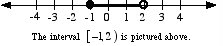
Here is a picture with an example of Interval Notation


Anatomy of Set Builder Notation
{ x
| -5>X ≥6 ; x ε R }

Meanings:

| -A vertical line meaning "such that"
R -(Supposed to be the sign of the Real Numbers) an example of the set of numbers from which we choose our values
ε -The greek letter Epsilon meaning " an element of" or "in the set of"

5>X ≥6 -An example of restrictions on the variable
Here is an equation for a parabola that will have a vertex at (0,0) and it might look like this on a graph

y=x² But if you wanted to move a parabola to the side you have to have the x-variable and have a constantin brackets and have it squared like this: y=(x-3)²
Well that's all of the Math dictionary entries we entered today and our next scribe is umm... Crysta. There seems to be something wrong with the font I think but I'll try to fix it later.
Until the next scribe page is up good luck and remember fractions are our friendsO.o