Showing posts with label Trigonometry. Show all posts

October 12, 2006

Trig Review: Trigonometrically Speaking Problem 2


LEGEND KEY

PURPLE - question/problem
GREEN - how to solve the problem
ORANGE - flashbacks
TEAL -
minor notes from me (not related to trig)
GOLD - answer in sentence form


PROBLEM #2:

An 11 cm long line AB is drawn at an angle of 44 degrees to a horizontal line AE. A circle with centre B and radius 9 cm is drawn, cutting the horizontal line at points C and D. Calculate the length of the chord (line segment) CD.

First, we draw a picture:

Then, we write down and show everything we know:

- distance of AB is 11 cm

- Angle A = 44 degrees

- the radius of the circle is 9 cm meaning that BD = 9 cm and BC = 9 cm and so does the majority of AB

- if we subtract the 9 cm from the 11 cm from line segment AB, we get a leftovers of 2 cm

We know what the length of BC is, which is 9 cm, and we know BC’s opposite angle (Angle A = 44 degrees), and we also know that the length of AB is, (AB = 11 cm), yet, we do not know AB’s opposite angle, Angle C. So we say that Angle C is theta and we use the sine law.

But because we are dealing with the SIN of theta, there are two possible values because there are two known angles in Quadrant I and Quadrant II on the Cartesian Plane for sine values.

Flashback:

This is possible because all the SIN, COS, and TAN values of theta in Quadrant I are positive; only the SIN values of theta in Quadrant II are positive; only the TAN values of theta in Quadrant III are positive; and only the COS values of theta in Quadrant IV are positive.

This is because...

For the SIN, COS, and TAN values in Quadrant I, all values are positive because the opp osite side, the adjacent side, and the hypotenuse will always have a positive value because it is going in a positive direction. Therefore, all values of SIN, COS, and TAN, are positive when theta is at the vertex with the origin.


For the SIN, COS, and TAN values in Quadrant II,

SIN is positive because the direction of the opposite side, where theta is at the vertex with the origin, is positive because it is going in a positive direction. The hypotenuse is always positive because it is referring to distance. SIN theta = opposite/hypotenuse. Opposite is positive and hypotenuse is positive, so positive/positive = positive.

COS is negative in Quadrant II because the direction of the adjacent side , where theta is at the vertex with the origin, is negative because it is going in a negative direction. The hypotenuse is always positive because it is referring to distance. COS theta = adjacent/hypotenuse. Adjacent is negative and hypotenuse is positive, so negative/positive = negative.

TAN is negative in Quadrant II because the direction of the opposite side, where theta is at the vertex with the origin, is positive, and adjacent is negative because the adjacent side is going in a negative direction on the Cartesian Plane. TAN theta = opposite/adjacent. Opposite is positive and adjacent is negative, so positive/negative = negative.

For the SIN, COS, and TAN values in Quadrant III,

SIN is negative because the direction of the opposite side, where theta is at the vertex with the origin, is negative because it is going in a negative direction. The hypotenuse is always positive because it is referring to distance. SIN theta = opposite/hypotenuse. Opposite is negative and hypotenuse is positive, so negative/positive = negative.

COS is negative because the direction of the adjacent side, where theta is at the vertex with the origin, is negative because it is going in a negative direction. The hypotenuse is always positive because it is referring to distance. COS theta = adjacent/hypotenuse. Adjacent is negative and hypotenuse is positive, so negative/positive = negative.

TAN is positive because the direction of the opposite and the adjacent side, where theta is at the vertex with the origin, is positive because it is going in a positive direction. TAN theta = opposite/adjacent. Opposite is positive and adjacent is positive, so positive/positive = positive.


For the SIN, COS, and TAN values in Quadrant IV,

SIN is negative because the direction of the opposite side, where theta is at the vertex with the origin, is negative because it is going in a negative direction. The hypotenuse is always positive because it is referring to distance. SIN theta = opposite/hypotenuse. Opposite is negative and hypotenuse is positive, so negative/positive = negative.

COS is positive because the direction of the opposite side and the hypotenuse, where theta is at the vertex with the origin, is positive because it is going in a positive direction. The hypotenuse is always positive because it is referring to distance. COS theta =adjacent/hypotenuse. Adjacent is positive and hypotenuse is positive, so positive/positive = positive.

TAN is negative because the direction of the opposite side, where theta is at the vertex with the origin, is negative because it is going in a negative direction. The adjacent side is positive because it is going in a positive direction. TAN theta = opposite/adjacent. Opposite is negative and adjacent is positive, so negative/positive = negative.

It is easy to remember all of this stuff by remembering the mnemonic “CAST” where C is placed in Quadrant IV meaning that all and only “c”osine values are positive in that quadrant, where A is placed in Quadrant I meaning that “A”ll values are positive in that quadrant, where S is placed in Quadrant II meaning that all and only “S”ine values are positive in that quadrant, and where T is placed in Quadrant III meaning that all and only “T”angent values are positive in that quadrant.

Now back to the question...

But because we are dealing with the SIN of theta, there are two possible values because there are two known angles in Quadrant I and Quadrant II on the Cartesian Plane. So we find the related angle as shown in the diagram below.

180 degrees – 58.1 degrees = 121.9 degrees.

121.9 degrees is the related angle meaning that both 58.1 degrees AND 121.9 degrees are possible values for Angle C of Triangle BCD.

BUT...

So we have the possible values of Angle C, which is 121.9 degrees of Triangle BCD, and its opposite side, BD, which equals 9 cm. We also have the possible value of Angle D, which is 121.9 degrees so all we need is the opposite side of Angle D of T riangle BCD.

The sum of the angles of any triangle is 180 degrees. Using this triangle’s trait,

180 degrees = Angle A + Angle B + Angle C

We re-arrange the formula so we can solve for Angle B.

Angle B = 180 degrees – Angle b – Angle C

We plug-in the values...

Angle B = 180 degrees – 121.9 degrees – 121.9 degrees
Angle B = -63.8

This is not possible because there is no such thing as a negative angle in a triangle. So we refer to this as an “ambiguous case” because the problem given is not clear on a few things. Well, believe it or not, we also have evidence that was overlooked from before in this problem, meaning that this “ambiguous case” might have also been predicted. We can predict if the problem is an ambiguous case when one of the sides of a triangle can “swing” from one side to another side when a circle is involved. See below for a diagram.

Using the process of elimination, where Angle C had two possible values: 58.1 degrees and 121.9 degrees, we now know that 121.9 degrees cannot be the answer to what we are looking for so 58.1 degrees is the answer we are looking for.

So we now know that Angle C of Triangle ABC is 121.9 degrees and Angle C of Triangle BCD is 58.1 degrees.

We know what the value of Angle C, which is 58.1 degrees, and we know the value of Angle C’s opposite side, BD, which is 9 cm, and we know that BC = 9 cm, then we can use the sine law to solve for Angle D.

Angle C & D = 180 degrees

Angle B = 180 degrees – 58 degrees – 58 degrees
Angle B = 64 degrees

We know the value of the angles C and D of triangle BCD which are both 58.1 degrees. We also know the value of the opposite side of Angle D which turns out to be 9 cm. With that in mind, we can use the sine law to finally figure out the value of CD.


The value of CD is approximately 8.59, rounded to the nearest hundredth.

yeah...so i'm still having sum technical difficulties so if the font seems all weird like this font is different than this font and u try to understand what the font pattern is, don't cuz the fonting wont change for sum "anonymous" (ha ha ha) reason. yeah...mz.anonymous will be our next scribe. in this case, it's SAMUS cuz m@rk thinks SAMUS = mz.anonymous.


October 11, 2006

Trig Review: Trigonometrically Speaking Problem 1

LEGEND KEY

PURPLE - question/problem
GREEN - how to solve the problem
PINK - titles/captions...
ORANGE - flashbacks
TEAL -
A/N (Author's Notes)
GOLD - answer in sentence form


so....kuropatwa started talking about computer programs and stuff and i wont go into detail on that 'cause i've found a much more easier way of doing things. based on kuropatwa's speculation on the BOB's, kuropatwa concludes that these two problems should give the students the most difficulty. we did two problems. i will label them "Problem #1" or "Problem #2."


FORMULA REVIEW


PYTHAGOREAN THEOREM

a^2 + b^2 = c^2

a and b are the legs of the triangle meaning that the values of a and b are interchangeable and c is the hypotenuse.

- recommended for right triangles


TRIGONOMETRIC RATIOS (SOH CAH TOA)

SOH meaning sin theta = opposite/hypotenuse
COH meaning cos theta = adjacent/hypotenuse
TOA meaning tan theta = opposite/adjacent

- recommended for right traingles


SINE LAW

- use sine law to find the side or angle of any triangle when an angle and its opposite side, and another angle OR side is given [recommended for oblique triangles (non-right triangles)]

(sin A / a) = (sin B / b) = (sin C / c) OR (a / sin A) = (b / sin B) = (c / sin C)

(a, b, and c are the sides of the triangle and A, B, and C are the angles)


COSINE LAW:

- use cosine law to find the side or angle of any triangle when SSS (side, side, side) or SAS (side, angle, side) are given. [recommended for oblique triangles]

a^2 = b^2 + c^2 - 2ab cos A

(a, b, and c, refers to the sides and A refers to the angle)

- this formula can be re-arranged to find the angle:

cos A = (b^2 + c^2 - a^2) / 2ac


yeah...so we will be using these forumlas in Problems 1 and 2.

just in case if you don't know...

angle of elevation - the angle that your line of sight that makes with the horizontal line when looking up

angle of depression - the angle that your line of sight that makes with the horizontal line when looking down


PROBLEM #1:

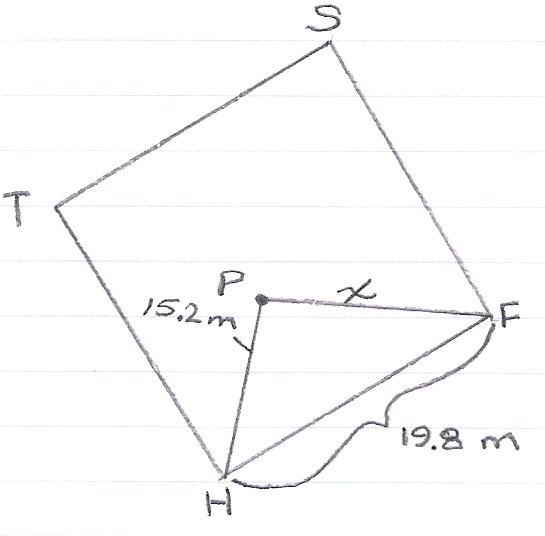
The pictcher's mound on a baseball diamond is 15.2 m from home plate. The distance between the bases is 19.8 m. How far is the pitcher's mound from the first base?

Step 1: Drawing the Diagram and Declaring Variables

first we draw a picture of the situation:


Then, we declare the variables:

P = pitcher's mound
H = home plate
F = first base
S = second base
T = third base
x = the unknown variable in which we are to find its value


Step 2: Using What We Know

- so we know that the distance from the pitcher's mound to the home plate is 15.2 m.

- in reality, a pitcher's mound is usually near the centre of the baseball diamond. so we cannot use SOH CAH TOA nor can we use a^2 + b^2 = c^2

- we also know that the distance between the bases is 19.8 m which is really the side of the square.

- we now know that the baseball diamond is in fact, a square which means it will possess the properties of a square:


Flashback:

Properties of a Square:


· All sides are congruent (the same).

· All angles are congruent (the same).

· Consecutive angles of a square are supplementary. [if you find the sum of two angles of a square that are side by side (consecutive), then they will equal 180 degrees.]

· Diagonals of a square bisect each other. (if you place a diagonal line from one angle of a square to its opposite, and you do the same with the other two remaining angels, then the two diagonal lines bisect each other)

· A square has congruent diagonals. (both diagonals in a square have the same distance. for example, if a diagonal line equals 60 cm, then the other diagonal of the square would equal 60 cm)


[Note: All the information on found on Image 1 is located from the image down to this sentence.]


with the properties of a square in mind, all of the angles of the square equals 90 degrees and we can draw two diagonals in the baseball diamond. if that's the case, then 4 triangles, with each of its vertex on the middle of the square, magically appear on the diagram. this leads us to the fact that each angle on each corner of the square equals 45 degrees.

[Note: All the information on found on Image 2 is located from the image down to this sentence.]


Step 3: Use the Formula

believe it or not, we have all the info we need on solving this predicament. our goal is to find the distance from P to F and soon, we will have that answer. to do that, we need to look at one of the triangles and in this case, it's the FHP triangle. because we can see that FHP is not a right triangle, then we have the values of SAS (side, angle, side) we shall use the magnificent cosine law.

cosine law:

a^2 = b^2 - 2ab*cos A

in this case,

- the variable "a" refers to a side of the triange which is also known as the distance from FH. in this case, a = 19.8.

- the variable "b" refers to a side of the triange which is also known as line segment HP. in this case, b = 15.2.

- the angle refered to as "A" has the value of 45 degrees

note that variables "a" and "b" are interchangeable meaning that it does not affect the result if PH = a or PH = b OR FH = a or FH = b.

so we use the cosine forumla and bada-boom, we've got this:

a^2 = b^2 - 2ab cos A

and we plug in the numbers, bada-bing, we've got this:

(PF)^2 = 15.2^2 + 19.8^2 - 2(15.2)(19.8) cos(15.2)

and so we calulate and BAM!.....

PF= 6.497...

which having it rounded to two digits:

PF = 6.5 metres


so how far is the pitcher's mound from first base?

The pitcher's mound is 6.5 metres far from first base.


trigonoBOBetrically speaking...

People may be wondering why my BOB is on this post instead of a separate post. that's cuz i'm having technical difficulties like the font changes by itself and i couldnt log on to this website saying that my connection was reset. lol. i thought i got hacked by mz.Anonymous. lol so just bear with me

let's see...trigonometry sounds hard at first but to me it wasn't that difficult. the more i struggled with the topics given, the more knowledgeable i become. =) My "moment of clarity" was the whole "graphing-the-waves" thing. All those terms, sinusoidal axis, amplitude, DAC, sounded very confusing but mr.k explained to me step-by-step. everything on how to 'graph-the-waves' became clear to me. mr.k says that if u forget how to 'graph-the-waves', then remember DAC. Well, i remembered DAC but i dont know what it stands for...but that wont matter to me now cuz i know exactly what to do when "graphing-the-waves."

October 10, 2006

Review on Trigonometry

Hi every one. On today's (October 10, 06) class we did a pre-test, which was a review on what we've been working on, in this unit. These are the problems and their solutions.

Q1 Find the length of 'x' in the figure below.
Note: The 1o` in triangle ADC wasn't given. We found that because we subtracted 30` from 40`.
IS X = a) 22 b)31 c)30 or d)52
The easiest way is to find the length of BC and BD using the trig. ratios (SOHCAHTOA) and then subtract BD from BC.
BC
tan(40) = BC / 200
BC = tan(40)*200
BC = 167.8

BD or h
tan(30) = BD / 200
BD = tan(30)*200
BD = 115.5

Therefore SINCE X=BC - BD
X=167.8 - 115.5
X=52.3
OR (d)


Q2 How many triangles can be constucted with A=30`, a=4, and b=10?
Is it: a) none b) 1 c) 2 d) Can't be determined?

First off lets try to sketch the info given.

Using the sine law
Sin(30) / 4 = SinB / 10
SinB = Sin(30)*10 / 4
SinB = 0.5 * 10 / 4
SinB=1.25
ooooops!?! THE MAX VALUE FOR SINE OF AN ANGLE IS 1 (The # is too big!)

Q3 SOLVE 3CosA - 2 = 0 so that A is greater than 0` and less than 360`

3Cos(A) - 2 = 0
3Cos(A)=2
Cos(A)=2/3

A=Cos inverse (2/3)
A = 48`
But since Cos is positive in Quadrant 4 as well we have to get the other value that could possibly have a related angle of 48`
Therefore the other angle =360`- 48`= 312`
The answer to the Q is: A = 48`, 312`

Q4 How would you calculate the reference of the angle J pictured below


Refrence or R
R = 180 - J
and you are done!

Q5 AHN OBSERVES THA ANGLE OF ELEVATION OF A PLANE TO BE 48`. AT THE SAME INSTANT, THE ANGLE OF ELEVATION FOR CRYSTAL IS 34`. AHN AND CRYSTAL ARE 80KM APART ON LEVEL GROUND.

A) How far is Ahn from the Plane?
B) How far is Crysta from the plane?
C) How high is the plane?


Step1 sketch the info given.
There are 2 ways that this triangle.

Whereby P=Plane A=Ahn C=Crytal

Note: That the numbers in blue weren't given, but we can get the numbers if we solve the triangle using the 180` principle.

A)
Sin(34`)/AP = Sin(98`)/80
AP = 80Sin(34`)/Sin(98`)

AP=45Km

Sin(14)/80 = Sin(34)/AP
AP = 80Sin(34)/Sin(14)
AP=237.9KM

B)
Sin(48`)/CP = Sin(98`)/80
CP=80Sin(48`)/Sin 98
CP=60KM

Sin(14`)/80 = Sin(132`)/CP
CP = 80Sin(132`) / Sin(14`)
CP=245.7KM

C)
Using trig. ratios
SinC = h/CP
Sin(34`) = h/60
h = 60Sin(34`)
h = 33.6KM

Using trig. ratios again
SinA = h/AP
Sin(48`) = h/237.9
h = 237.9Sin(48`)
h=176.8KM


I think I'm done.
.
.
The next scribe will be.
.
.
-Zeph


September 29, 2006

Finding the Quadrants of Trig

Hi it's me Ben. Today in class we had to work on two worksheets because unfortunately Mr. K was off to a Math workshop :-( Our substitute got us started by helping us with the first few questions on the first worksheet. Here's what he explained:

The first question ask for the values of Θ on the interval 0°≤
Θ ≤ 360° for the following questions and I have added a picture to help understand:
A)sin
Θ<0>Θ>0
B)sinΘ>0 and cosΘ≤0
C)tanΘ>0
D)cos
Θ≤0

Quadrant I:
sin
Θ›O
cos
Θ›O
tan
Θ›O
Reason: The value/ratio of sin, cos, tan is positive therfore in the 1st quadrant

Quadrant II:
sin
Θ›O
cos
Θ‹O
tan
Θ‹O
Reason: The value/ratio of sin
Θ is positive while cosΘ and tanΘ are negative

Quadrant III:
sin
Θ‹O
cos
Θ‹O
tan
Θ›O
Reason: The value/ratio of sinΘ and cosΘ is negative while tanΘ is positive

Quadrant IV:
sin
Θ‹O
cos
Θ›O
tan
Θ‹O
Reason: The value/ratio of sinΘ and tanΘ is negative while cosΘ is positive

The question is asking which quadrant is each condition found so:
A) sin
Θ‹O and cosΘ›O
Answer: Quadrant IV because sinΘ is negative and cosΘ is positive and the only quadrant where that happens is in quadrant IV

B)sin
Θ>O and cosΘ≤O
Answer: Quadrant II because sin
Θ is positive and cosΘ is negative and the only quadrant where that is true is in quadrant II

C)tan
Θ>O
Answer: Quadrant I and III because the only quadrant where that is true is in quadrant I and III

D)cos
Θ≤O
Answer: Quadrant II and III because that only quadrant where that is true is in quadrant II and III

The next thing he explained helped us remember what each variable of the Sin/Cos Wave Formula stood for:

y=A sin B (x-C) +D
y=A cos B(x-C) +D

A-The A represents the amplitude or the direction of opening
B- The B tells us how much the wave is horizontally compressed but unfortunately B is taught in grade 12 not in grade 11
C- The C represents the Phase Shift which tells us the horizontal shift or how far the wave is moved on the x-axis
D- The D represents the Sinusoildal Axis which tells us the vertical shift or how far the wave is moved on the y-axis

With that information in mind we were able to finish the second work sheet which told us to state the amplitude, vertical shift, and horizontal shift.

Well that's my edition of the scribe and I hope this helps everybody that reads this to understand trigonometric functions on the Cartisian Plain. Oh yeah the scribe for tomorrow is the one and only... Mel!issa. Have fun and good night y'all!
www.flickr.com
This is a Flickr badge showing public photos from Flickr tagged with pc30sf06. Make your own badge here.

Check out the entire collection!