Well to start things off we had quiz. The quiz was of course on logic, inductive, deductive, valid and invalid questions. A inductive statement is where you have examples and make a generalization and deductive statement is where you have a generalization and produce an example. The part I thought some of us had problems with was determining whether a statement was valid and invalid. Anyways tomorrow might be the logic test so remember to have your BOB's up just in case. Besides the quiz we had a lot of writing to do in our math dictionaries some new and old things.
MATH DICTIONARY
Some definitions
Set: A collection of objects (could be people, things, numbers etc.)
Subset: A collection of objects that consists of some, all or none of the objects in a given set
Example: Consider set A :(1,2,3)
All of the following are subsets of A : (1), (2), (3), (1,2), (1,3), (2,3), (1,2,3),
Note:is called the "empty set" or "null set" but is still a subset of every set
Universe (U) : all objects are being considered
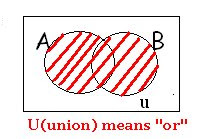
Notation: Union U A U B means gather all objects in set A with all objects in set B

Notation: Intersection
 means gather all the objects that are both in set A and B

- or ' compliment: (reads as " the compliment of A" or "A compliment") means everything outside A

 exclusion:
  means everything that is in set A but not set B

Counterexample: Given any logical argument, theorem or hypothesis, if you can find only one case where it is not true, then the theorem or argument is proven false . This is called a "counterexamlple"
Conditional statements: Any statement of the form" If...then..." is called a "conditional" or "implication"
Hypothesis: The first part of the conditional
Conclusion: The second part of a conditional
Example: If(hypothesis) Then(conclusion)
If a triangle is isosceles Then it's base angles are congruent

Well that's all for this scribe and I'll scribe on Friday since I couldn't get my post up in time.
Homework is Ex. 48
Flickr assignment due this Friday
Go for Gold due Wednesday before exam
and our 2nd consumer packet

Set: A collection of objects (could be people, things, numbers etc.)
Subset: A collection of objects that consists of some, all or none of the objects in a given set
Example: Consider set A :(1,2,3)
All of the following are subsets of A : (1), (2), (3), (1,2), (1,3), (2,3), (1,2,3),

Note:
is called the "empty set" or "null set" but is still a subset of every setUniverse (U) : all objects are being considered
Notation: Union U A U B means gather all objects in set A with all objects in set B


Notation:
 Intersection
 means gather all the objects that are both in set A and B
- or ' compliment:
 (reads as " the compliment of A" or "A compliment") means everything outside A
 exclusion:
  means everything that is in set A but not set B
Counterexample: Given any logical argument, theorem or hypothesis, if you can find only one case where it is not true, then the theorem or argument is proven false . This is called a "counterexamlple"
Conditional statements: Any statement of the form" If...then..." is called a "conditional" or "implication"
Hypothesis: The first part of the conditional
Conclusion: The second part of a conditional
Example: If(hypothesis) Then(conclusion)
If a triangle is isosceles Then it's base angles are congruent
Arguments of the form"if..then..." and related statements

A sentence that says only one thing is called a "declarative sentence"
Well that's all for this scribe and I'll scribe on Friday since I couldn't get my post up in time.
Homework is Ex. 48
Flickr assignment due this Friday
Go for Gold due Wednesday before exam
and our 2nd consumer packet


