Good evening everyonethis is m@rk scribing for yesterday's class. I've been banged up by high fever that is why i was unable to go to class today.
To start yesterday's class we proved using direct reasoning that the product of 2 even numbers is even too.First of all an even number is something that is divisible by 2 and has a factor of 2.
Let 2x=an even number
2a=another even number
2x * 2a =4ax
2x * 2a= 2 (2ax)
∴ Any product by both even numbers is also even as seen from above.
Then, we proved using direct reasoning that the product of 2 odd numbers is odd too.
Let (2x+1) =an odd number
(2a+1) = another odd number
(2x+1) (2a+1) =4ax+2x+2a+1
(2x+1) (2a+1)=2 (2ax+x+a) 1
∴ Any product by both odd numbers is also odd as seen from above because the product does not factor perfectly with 2.
Now, from the previous class we proved that √2 is irrational using indirect reasoning.
First, assume that √2 is rational.
√2=a/b
Note: a/b is in reduced form meaning they have no common factors.
2= a²/b² Multiply both sides by b²
2b² =a²
a² must be an even number and a must be even too so, let a=2c.
2b² = (2c)²
2b²=4c²
b²=2c²
b² and b are both even numbers so, let b=2d. This is a contradiction! Both a and b cannot have any common factors because of our assumption that they are in reduced forms in the beginning.
∴ √2 is irrational
Then, we prooved that √3 is irrational using indirect reasoning.
First, assume that √3 is rational. THis problem is similar to the the previous one.
√3= a/b
Assume that a/b is in reduced form.
3= a²/b²
3b² = a²
On the other hand lets look at square numbers first.
4= 2*2
9=3*3
16=2*2*2*2
25=5*5
36=2*3*2*3
49=7*7
64=2*2*2*2*2*2
81=3*3*3*3
100=5*2*5*2
Can you see the pattern that there is always a pair of prime numbers in square numbers?
So let b²=3c
3(3c)² =a ²
3* 9c² =a²
BUt it cannot happen because a and b will share the same factor which is 3. Therefore contradicting with our first statement that a and b is in reduced form.
∴√3 is irrational
Lastly, we talked about pardoxes. A paradox is a statement that cannot be true but also cannot be false.
Example:
This sentence is false
In this case you cannot decide whether it is true or false.
Thats it for my scribe for tonight. I dont know if im going to be able to go to class tomorrow. It all depends if im feeling better . LIke i told Mr. K the scribe will be Natnael. The homework is the Unusual school play
Showing posts with label Logic. Show all posts
Showing posts with label Logic. Show all posts
January 16, 2007


BOB
Another unit test coming up. For me, logic was a lot harder than I thought it would be. Even if it's not that easy, I personally enjoy the challenge of finding the solutions. I've had experience with these kinds of problems in junior high, so I have a good starting idea as to how to approach the question. I just hope that we all do really good on this test, and hopefully, I get the mark I've worked to get. 'Night!
BOB v.6 The LOGICal Bob
Well I can't say the logic unit was straight forward since we now know about the paradoxes. It was fun though doing those paradox assignments on "A Usual Day at an Unusual School." Venn Diagrams were easy to do and so were the matrix problems. It felt like doing jr.high stuff but more advance. It was awesome learning logic in math class where we discuss things that barely have to do with numbers as compared to the other unit we're doing - consumer math. We discussed confusing things suchas "the inverse is the converse of the contrapositive" and the existence of counterexamples. Learning logic was fun and very interesting and the countdown begins for the logic test to show.
-Zeph
-Zeph
January 15, 2007
Usual Day At Unusual School
We talked about proof by contradiction in the last couple of classes. Today we proved that √2 is irrational using proof by contradiction (which is also called, in latin, reductio ad absurdum). You can also review direct proof here (use the pop-up menu to review indirect proof and other topics as well).
Tonight's homework is the play below. Make a list of all the Braves and Brights. We'll discuss it in class tomorrow. ;-)
Page 1 of 4 Page 2 of 4 Page 3 of 4 Page 4 of 4
Tonight's homework is the play below. Make a list of all the Braves and Brights. We'll discuss it in class tomorrow. ;-)
Page 1 of 4 Page 2 of 4 Page 3 of 4 Page 4 of 4
January 13, 2007
Well like yesterday to start things off we had another quiz. The quiz was not on valid and invalid questions but learning how to draw venn-diagrams based on word problems. I thought the quiz was a little easier than yesterdays. Well after going over the quiz we got off topic and had an interesting discussion about this new device called a smart board. Well the smart board is a school board and a computer in one. It's basically an interactive white board. It's sound really cool and I hope Mr.K gets it in time for us to use it next semester.
Besides chatting about this cool smart board we actually did do some work. We learned about Direct and Indirect prove.
Direct Prove would be Thales' Theorem. We know if an inscribed angle in a circle is subtended by a diameter, then the angle is 90 degrees. Also that 2x+2y=180 degrees or that simplified x+y=90 degrees, as shown below.

Indirect prove is where you begin assuming the opposite of what we want to prove.
So here was the example that we worked on in class
Given triangle ABC with point D on line BC
Prove: If Line AB = AC
and angle BAD doesn't equal angle CAD
then line BD doesn't equal line CD
(so we start we assuming the opposite
line BD = line CD) "a contradiction"


That was the only example that we got to but the next scribe will be able to scribe on the good stuff as Mr. K described the ones we didn't get to yet.
Well the next scribe is m@rk so have fun ...........
Remember our go for golds due Wednesday before exams
and one of our two consumer worksheets on Monday
Besides chatting about this cool smart board we actually did do some work. We learned about Direct and Indirect prove.
Direct Prove would be Thales' Theorem. We know if an inscribed angle in a circle is subtended by a diameter, then the angle is 90 degrees. Also that 2x+2y=180 degrees or that simplified x+y=90 degrees, as shown below.

Indirect prove is where you begin assuming the opposite of what we want to prove.
So here was the example that we worked on in class
Given triangle ABC with point D on line BC
Prove: If Line AB = AC
and angle BAD doesn't equal angle CAD
then line BD doesn't equal line CD
(so we start we assuming the opposite
line BD = line CD) "a contradiction"


That was the only example that we got to but the next scribe will be able to scribe on the good stuff as Mr. K described the ones we didn't get to yet.
Well the next scribe is m@rk so have fun ...........
Remember our go for golds due Wednesday before exams
and one of our two consumer worksheets on Monday
January 11, 2007
Hey guys exams are coming.
Well to start things off we had quiz. The quiz was of course on logic, inductive, deductive, valid and invalid questions. A inductive statement is where you have examples and make a generalization and deductive statement is where you have a generalization and produce an example. The part I thought some of us had problems with was determining whether a statement was valid and invalid. Anyways tomorrow might be the logic test so remember to have your BOB's up just in case. Besides the quiz we had a lot of writing to do in our math dictionaries some new and old things.
Well to start things off we had quiz. The quiz was of course on logic, inductive, deductive, valid and invalid questions. A inductive statement is where you have examples and make a generalization and deductive statement is where you have a generalization and produce an example. The part I thought some of us had problems with was determining whether a statement was valid and invalid. Anyways tomorrow might be the logic test so remember to have your BOB's up just in case. Besides the quiz we had a lot of writing to do in our math dictionaries some new and old things.
MATH DICTIONARY
Some definitions
Set: A collection of objects (could be people, things, numbers etc.)
Subset: A collection of objects that consists of some, all or none of the objects in a given set
Example: Consider set A :(1,2,3)
All of the following are subsets of A : (1), (2), (3), (1,2), (1,3), (2,3), (1,2,3),
Note:is called the "empty set" or "null set" but is still a subset of every set
Universe (U) : all objects are being considered
Notation: Union U A U B means gather all objects in set A with all objects in set B
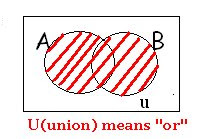

Notation: Intersection
 means gather all the objects that are both in set A and B

- or ' compliment: (reads as " the compliment of A" or "A compliment") means everything outside A

 exclusion:
  means everything that is in set A but not set B

Counterexample: Given any logical argument, theorem or hypothesis, if you can find only one case where it is not true, then the theorem or argument is proven false . This is called a "counterexamlple"
Conditional statements: Any statement of the form" If...then..." is called a "conditional" or "implication"
Hypothesis: The first part of the conditional
Conclusion: The second part of a conditional
Example: If(hypothesis) Then(conclusion)
If a triangle is isosceles Then it's base angles are congruent

Well that's all for this scribe and I'll scribe on Friday since I couldn't get my post up in time.
Homework is Ex. 48
Flickr assignment due this Friday
Go for Gold due Wednesday before exam
and our 2nd consumer packet

Set: A collection of objects (could be people, things, numbers etc.)
Subset: A collection of objects that consists of some, all or none of the objects in a given set
Example: Consider set A :(1,2,3)
All of the following are subsets of A : (1), (2), (3), (1,2), (1,3), (2,3), (1,2,3),

Note:
is called the "empty set" or "null set" but is still a subset of every setUniverse (U) : all objects are being considered
Notation: Union U A U B means gather all objects in set A with all objects in set B


Notation:
 Intersection
 means gather all the objects that are both in set A and B
- or ' compliment:
 (reads as " the compliment of A" or "A compliment") means everything outside A
 exclusion:
  means everything that is in set A but not set B
Counterexample: Given any logical argument, theorem or hypothesis, if you can find only one case where it is not true, then the theorem or argument is proven false . This is called a "counterexamlple"
Conditional statements: Any statement of the form" If...then..." is called a "conditional" or "implication"
Hypothesis: The first part of the conditional
Conclusion: The second part of a conditional
Example: If(hypothesis) Then(conclusion)
If a triangle is isosceles Then it's base angles are congruent
Arguments of the form"if..then..." and related statements

A sentence that says only one thing is called a "declarative sentence"
Well that's all for this scribe and I'll scribe on Friday since I couldn't get my post up in time.
Homework is Ex. 48
Flickr assignment due this Friday
Go for Gold due Wednesday before exam
and our 2nd consumer packet
January 08, 2007
New Year With Continuation of Last Year's Class
Hi and happy new year everybody and I hope you all had a great holiday. Today we continued on what we left off on the last day of school before the holidays. We worked on some word problems that had to do with Venn- Diagrams. These are the questions:
1. Recently several DMCI students were surveyed about their favourite music groups.
The results were:
b) How many students liked U2 only?
c) How many students like exactly 2 groups
2.Every year over 9 million tourists visit Turkey. Last year 9.8 million tourists vistited Turkey.
Solutions
1.So first we fill in a three circle venn diagram because there are 3 different groups.
I'll explain the diagram, first we work our way from the middle and we know that there are 6 people who like all three groups. Now we pick one of the next 3 overlaps and find those. Lets use U2 & Hole as an example, we know from the clues that 9 people liked Hole & U2 so we subtract 6 from the 9 because the 6 represents 6 people that also like Hole & U2. So we have 3 in that section. Once those sections are complete we work on the outer sections. Like the overlaps we take the total number of people that like that group and subtract the number of people that like that group and other groups also.
a)This question asks us to find the number of students survey, so we just add all the numbers up and we get 50
b)This question asks us to find the number of students who only liked U2 and the answer is 2 according to the graph
c)This question asks us to find the number of students who like only 2 groups and the answer is 28. We get that by adding the numbers that are in the section of 1 overlap which are 3, 11, 14.
2.This quest is a doozy because we have to go back and forth with the clues.
1. Recently several DMCI students were surveyed about their favourite music groups.
The results were:
- 22 like Hole
- 25 like U2
- 39 like Third Eye Blind (TEB)
- 9 like U2 & Hole
- 17 like Hole & TEB
- 20 like U2 & TEB
- 6 like all three
- 4 like non of these three
b) How many students liked U2 only?
c) How many students like exactly 2 groups
2.Every year over 9 million tourists visit Turkey. Last year 9.8 million tourists vistited Turkey.
- 60% visited only Istanbul
- 20% visited Izmir
- Half of the tourists who visited Izmir also visited Istanbul
- 2% visited Istanbul, Izmir, and Antalya
- The number of tourists who visited only Antalya was half again as much as the number of the tourists who only visited Izmir
- Tourists who visited Antalya either saw only Antalya or Antalya, Istanbul, and Izmir
- The rest of the tourists visited other regions
Solutions
1.So first we fill in a three circle venn diagram because there are 3 different groups.

I'll explain the diagram, first we work our way from the middle and we know that there are 6 people who like all three groups. Now we pick one of the next 3 overlaps and find those. Lets use U2 & Hole as an example, we know from the clues that 9 people liked Hole & U2 so we subtract 6 from the 9 because the 6 represents 6 people that also like Hole & U2. So we have 3 in that section. Once those sections are complete we work on the outer sections. Like the overlaps we take the total number of people that like that group and subtract the number of people that like that group and other groups also.
a)This question asks us to find the number of students survey, so we just add all the numbers up and we get 50
b)This question asks us to find the number of students who only liked U2 and the answer is 2 according to the graph
c)This question asks us to find the number of students who like only 2 groups and the answer is 28. We get that by adding the numbers that are in the section of 1 overlap which are 3, 11, 14.
2.This quest is a doozy because we have to go back and forth with the clues.
If the pictures are going too fast, feel free to pause or replay.
After the explanation of those two questions we began with a new logic subject.
Mr. K told us to take out a new piece of loose leaf and draw the biggest circle you can draw on that paper and make a dot on the circumference. Then he asked us how many different flat areas there are in the circle and there are 1. He told us to make a second dot and connect the dots and asked us how many areas are there and there were 2. Then a 3rd dot and then connect that dot with every other dot and then do the same as before and there were 4 areas. Now look at the graph.
This album is powered byBubbleShare
- Add to my blog
So lets think of an equation to helps us find the number of areas if the number of points is 457.
As a class we discovered that the equation 2(n-1) where n is the number points will work. So we tried the equation with 6 as the number of points and using the equation we predicted the number of areas will be 32. Now continue with the diagram with 6 dots and count the number of areas. Oh no there is only 31. That is situation called a counterexamples and that is when there is a theorem made and there is one example that doesn't fit the theorem. That just makes the theorem a theorem that is not true. Tomorrow will be the continuation about counterexamples.
Okay that was our first class back from the holidays and it was kind of tiring to go back to school after a 2 week break. Homework (homework*sigh*) is exercise #48 and it is about counterexamples.
The next scribe will be SAMUS!!!
Good Night :-)
- The first picture shows inserting the info from the first clue and from the clue it tells us that 60% of the total tourists visited only Istanbul. We can put it on the venn diagram because the clue states that 60% visited only Istanbul.
- The second picture shows the third clue and with the second clue in mind we can find the Istanbul- Izmir overlap because the clue states that half of the number of tourists that visited Izmir also visited Istanbul. So half of 20% is 10% and that leaves us with 10% for Izmir.
- The third picture shows the addition of the middle section with the forth clue.
- The forth picture shows the sixth clue which states that the people who visited Antalya only visited Antalya or saw all three places and not 2 places. So we know that the Izmir-Antalya and Istanbul-Antalya sections have 0%'s. And now we can find how many people visited Izmir and it is 8% because before we had 10% and due to the forth cluwe are left with 8% and that 8% go into the Izmir section.
- The fifth picture shows the fifth clue and it states that the people that visited Antalya is equal to 1.5x the number of people who visited Izmir and 8 x 1.5= 12. So Antalya is 12%.
- The final picture shows the addition of the last clue which states that the remainder of the tourists visited other regions.
After the explanation of those two questions we began with a new logic subject.
Mr. K told us to take out a new piece of loose leaf and draw the biggest circle you can draw on that paper and make a dot on the circumference. Then he asked us how many different flat areas there are in the circle and there are 1. He told us to make a second dot and connect the dots and asked us how many areas are there and there were 2. Then a 3rd dot and then connect that dot with every other dot and then do the same as before and there were 4 areas. Now look
 at the graph.
This album is powered byBubbleShare
- Add to my blog
So lets think of an equation to helps us find the number of areas if the number of points is 457.
As a class we discovered that the equation 2(n-1) where n is the number points will work. So we tried the equation with 6 as the number of points and using the equation we predicted the number of areas will be 32. Now continue with the diagram with 6 dots and count the number of areas. Oh no there is only 31. That is situation called a counterexamples and that is when there is a theorem made and there is one example that doesn't fit the theorem. That just makes the theorem a theorem that is not true. Tomorrow will be the continuation about counterexamples.
Okay that was our first class back from the holidays and it was kind of tiring to go back to school after a 2 week break. Homework (homework*sigh*) is exercise #48 and it is about counterexamples.
The next scribe will be SAMUS!!!
Good Night :-)
January 07, 2007
VEry ...very late post
Ok, everyone I hoped you had some very good days of rest. Now, let's start with the math. I know that this should have been posted a long time ago but my computer sort of meltdown.First of all I need to thank my cousins for fixing my computer and making me recovery disks.
Last two weeks we reviewed the questions from our circle unit. The first question was:
Given:
line AP and line AQ are tangents
Arcs BS and RE are congruent
Angles 2 and 5 are congruent
Prove that lines BC and ED are congruent
 Statement and Reason
Lines AB and AE are congruent Tangent Theorem
Angles 3 and 4 are congruent Inscribed Angle Theorem
Triangles ABC and AED are congruent Angle-angle-side
LInes BC and ED are congruent From above
The second question was:
Isosceles triangle ABC is inscribed in a circle with a diameter 12 cm. Side AB is a diameter. Determine the length of BC.
 Let X=the length of lines AC and BC.
Then use the phythagorean theorem
x^2+x^2=12^2 2x^2=144
x^2=72
x=√72
x=6√2
The third question was:
Quadrilateral PQRS is inscribed in a circle. Side PQ is parallel to side SR. The diagonals intersect at T. Prove that triangles TSR and TPQ are isosceles.
 Statement and Reason
Arcs PS and QR are congruent Parallel Chords Theorem
Lines PT and QT are congruent Congruent chords theorem
Lines ST and RT are congruent Congruent chords theorem
TRiangles TSR and TPQ are isosceles From above
The fourth one was:
The circle with centre O has 4 points of tangencyA,B,C and D.Angle AEB =30°, angle ADC=90, and Angle DCB=85.FInd the measure of angle CDG. Statement And Reason
Angle BAD=95 Cyclic Quadrilateral Theorem
LInes EA and EB are congruent Tangent theorem
Triangle AEB is isosceles From above
Angles EAB and EBA=75 BAse Angles
LInes HD and HA are congruent Tangent theorem
Angle HAD =10 Supplementary angles
Angle HDA=10 base angles
Angle CDG=80 Supplementary angle
Then after we reviewed the test we practiced on more stuff on Logic
The first question was: A survey of 80 students showed that 45 like rock music, 25 liked country and 10 liked both. How many liked neither?
 The second question was:
140 homes are surveyed 90 have a stereo, 70 have a DVD player and 40 have both. HOw many have neither?
 The last question was:
150 people were surveyed on their reading preferences
90- mystery
70- history novels
45-sci-fi
30-mystery and history
25- mystery and sci-fi
22-history and scifi
10 -reads all 3
How many read
1. At least one type of book
2. Exactly one type
3 Exactly two types
4. Do not read any of the 3 types
 That's it for this edition of my scribe. Again, i'm sorry for the images because my paint and RFXsoftware is not working properly eversince last year. I must admit that i need a new computer.
REMINDERS
Flicker Assignment (trigonometry)
DElicious (Put at least one link for every unit we finished)
Last two weeks we reviewed the questions from our circle unit. The first question was:
Given:
line AP and line AQ are tangents
Arcs BS and RE are congruent
Angles 2 and 5 are congruent
Prove that lines BC and ED are congruent
Statement and ReasonLines AB and AE are congruent Tangent Theorem
Angles 3 and 4 are congruent Inscribed Angle Theorem
Triangles ABC and AED are congruent Angle-angle-side
LInes BC and ED are congruent From above
The second question was:
Isosceles triangle ABC is inscribed in a circle with a diameter 12 cm. Side AB is a diameter. Determine the length of BC.
Let X=the length of lines AC and BC.Then use the phythagorean theorem
x^2+x^2=12^2 2x^2=144
x^2=72
x=√72
x=6√2
The third question was:
Quadrilateral PQRS is inscribed in a circle. Side PQ is parallel to side SR. The diagonals intersect at T. Prove that triangles TSR and TPQ are isosceles.
Statement and ReasonArcs PS and QR are congruent Parallel Chords Theorem
Lines PT and QT are congruent Congruent chords theorem
Lines ST and RT are congruent Congruent chords theorem
TRiangles TSR and TPQ are isosceles From above
The fourth one was:
The circle with centre O has 4 points of tangencyA,B,C and D.Angle AEB =30°, angle ADC=90, and Angle DCB=85.FInd the measure of angle CDG.
Statement And ReasonAngle BAD=95 Cyclic Quadrilateral Theorem
LInes EA and EB are congruent Tangent theorem
Triangle AEB is isosceles From above
Angles EAB and EBA=75 BAse Angles
LInes HD and HA are congruent Tangent theorem
Angle HAD =10 Supplementary angles
Angle HDA=10 base angles
Angle CDG=80 Supplementary angle
Then after we reviewed the test we practiced on more stuff on Logic
The first question was: A survey of 80 students showed that 45 like rock music, 25 liked country and 10 liked both. How many liked neither?
The second question was:140 homes are surveyed 90 have a stereo, 70 have a DVD player and 40 have both. HOw many have neither?
The last question was:150 people were surveyed on their reading preferences
90- mystery
70- history novels
45-sci-fi
30-mystery and history
25- mystery and sci-fi
22-history and scifi
10 -reads all 3
How many read
1. At least one type of book
2. Exactly one type
3 Exactly two types
4. Do not read any of the 3 types
That's it for this edition of my scribe. Again, i'm sorry for the images because my paint and RFXsoftware is not working properly eversince last year. I must admit that i need a new computer.REMINDERS
Flicker Assignment (trigonometry)
DElicious (Put at least one link for every unit we finished)
December 19, 2006
" L O G i C " - cont'd
To start off today's class, we were given a few reminders:
- FLICKR.com RUBRIC: Reminder to students that this is for your benefit. Putting in your voice nto this document will affect how your flickr assignments are graded. This document should be about how you want your assignments to be marked, and how the assignments should be done. Get crackin'!
- NEXT FLICKR ASSIGNMENT: The next flickr assignment will be to take a picture of TRIGONOMETRY. Be unique and creative and find a photo no one else will have. This won't be due until the first tuesday after winter break. We'll be given a great amont of time for this assignment, but don't procrastinate!
Today, we added in some more notes into our math dictionary:

Here are a few examples of some arguments:

Example 1 and 2 both are true and valid statements. The reason being the premises of each example makes sense with what the conclusion says. The conclusion makes sense of what has been stated and flows naturally. This is called a sound argument.
SOUND ARGUMENT: an argument that is both valid and true.
AN EXAMPLE OF A FALSE ARGUMENT:
"All men are mortal.
Mr. K is a man
... Mr. K wears glasses."
That was a false statement because, even if the three statements alone are true, together as an argument, it's not. The conclusion doesn't flow naturally with the premises, and it doesn't make sense.
**************************************
We also discussed different TYPES OF REASONING that we go over in this unit of Logic:
Induction: When we observe several particular examples that identify a pattern and conjecture that it must always be that case.
EXAMPLES:
QUESTION: Will the sun rise tomorrow?
ANSWER: It has every day before, so it will rise again tomorrow.
*That's the answer because through all the years we've been living, a reoccurring pattern of the sunrise has always taken place.
NOTE: To view more examples of inductive reasoning, look over all the investigations we worked on in our circle geometry unit!
Deduction: When we argue from basic, unarguable truths, to a valid conclusion.
An example of deductive reasoning is the process of proving THALES' THEOREM.

***************************************
In logic, we also look at relationships between different sets, and compare them in Venn Diagrams.
In the following images, we see how sets are made, and how we can compare two different sets using a venn diagram.


***************************************
Weeell ..
TOMORROW'S THE DAY! CIRCLE GEOMETRY UNIT TEST
I HOPE YOU GUYS ENJOYED MY SCRIBE..
blogger was being a pain in the behind and erased my
first draft and I had to start all over again!
BUT, I DID IT AGAIN. YET ANOTHER SCRIBE POST BY ME!
TOMORROW'S SCRIBE WILL BE ...
M@RK.
(just cuz he told me to pick him!)
NiGHT!!
Subscribe to:
Posts (Atom)


